
UP!
By the end of this century, humanity faces two primary goals:
To build a new model for society — the Strive Society — that shifts the gears from security competition for survival and wealth accumulation as an end for an individual, organization, and state toward a new mindset and world order architecture that establishes competition for survival of humanity, permanent striving for the ultimate, and grasping the Universe.
This requires both the architectural will of humanity and fundamental innovations — only they create new core premises that change the capability set and balance of power, allowing for new system designs. This century, we must focus on:
- transition from the Internet of applications to the Internet of Intelligences,
- nanotechnology (atomic-level construction),
- fusion (minimize costs and maximize energy efficiency),
- brain–computer interfaces (with the potential for mind immortality),
- colonization of the Solar System,
- synthetic biology.
In a society emerging from these premises with the right steering, it'll be possible to create a world order and financial system that distribute profits in favor of those who invent the new and really influential, while eliminating zero-value wealth generators: speculative trading, transactional middlemen, etc.
GDP can be replaced by the cognitive-intellectual development: the complexity of individual cognitive labor, the rate of overturning scientific theories, the production of innovation and new knowledge. The fundamental role and function of states and cities will shift to 'make you capable of more' — which requires moving beyond the nation-state idea, technologically removing language barriers, and securing free movement within the new order group of countries.
We can't deprive countries and groups of the capacity to destroy one another, but we can make it technically unfeasible through the institution of common unconditional security, enforced by absolute algorithmic determinism.
Every person will strive for ever-better results in everything they do, amidst a constant competition of countries for people and vice versa — this must become our new default mindset.
To answer the three Fundamental Questions of Humanity for this century:
- What is life? (Universal theory of life) Is de facto indefinite life possible?
- What is intelligence? (Universal theory of intelligence) And how does the brain work? (Universal science of the brain)
- How did the Universe emerge? Why are the observed laws of physics exactly as they are?
Religious focus on these questions will incentivize investment in solving dark matter, biological aging, neural decoding, and more.
System
Our long-term goal is to provide humanity with a nonstop stream of fundamental innovation in practical perpetuity.
VC, corporate R&D, and the state succeed in this only sporadically, and achieving this goal requires a new architecture of a different type of civilizationally important institution that has:
- freedom to shift niches from one innovation to the next
- autonomy from the past products' business interests
- immunity to state geopolitical ambitions within security competition
- immunity to short-term stakeholder interests
To date, no system has managed to simultaneously satisfy all four criteria under current market and state designs. We haven't solved it yet — our current thinking:
We intend to create a system that functions as a self-perpetuating multi-startup, cyclically renewing ~90% of its roster from project to project, each pursuing the creation and market launch of a fundamental innovation. At the end of the project → active product → independent brand cycle, the latter becomes an autonomous company, and the stake in it is gradually realized for reinvestment into the next project; the previous product niche is systematically abandoned. Teams working on active products move into independent brands virtually intact.
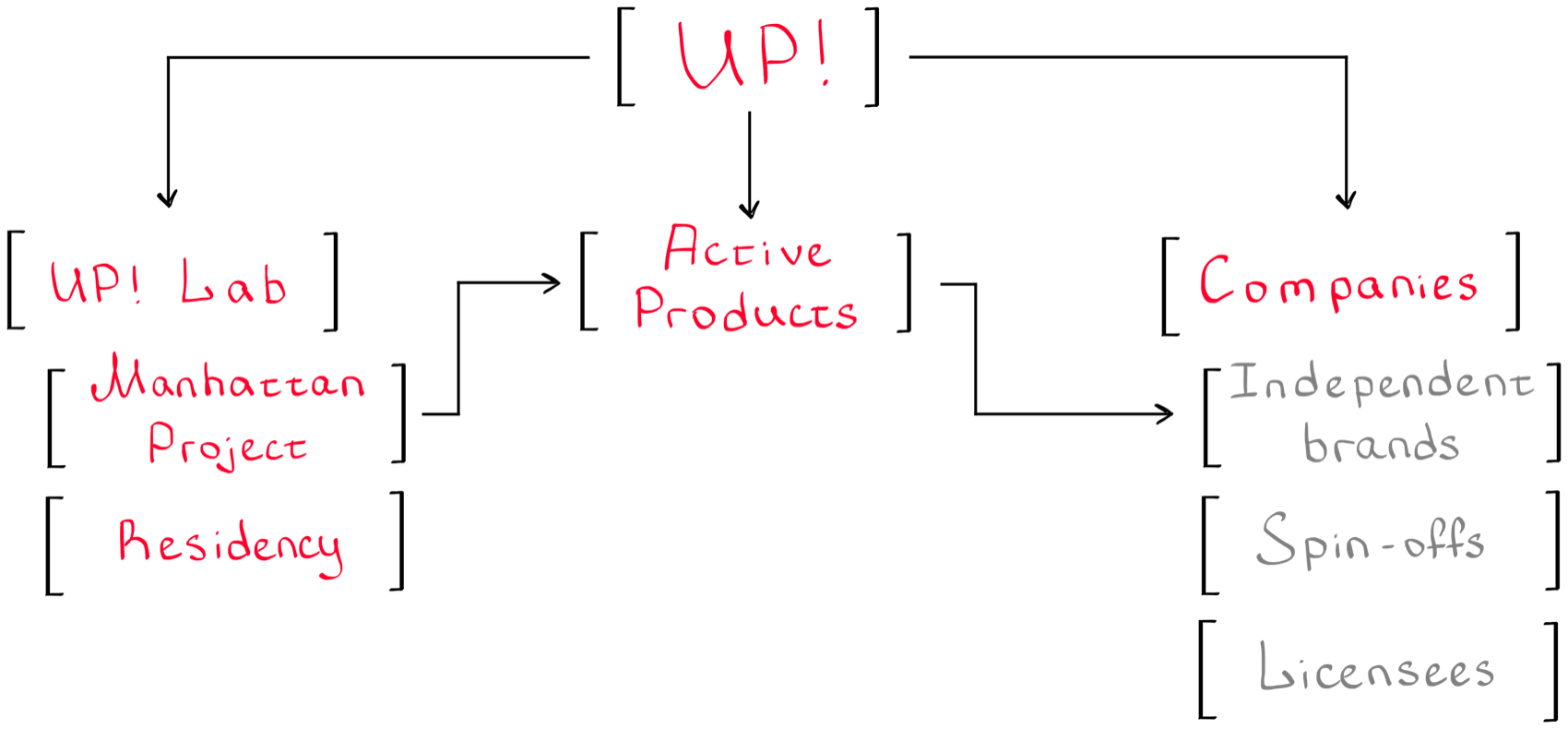
This design forces permanent fitness, excluding business model protection in favor of being a risk-aggressive, self-renewing organism.
First project
Today's AI leaders (and states relying on them) are pushing in a strategically broken direction: cloud computing, centralized control of data, and convergence of all AI capabilities into a single 'assistant'.
We hold that an integral part of human development is an AI interface between humans and all global technologies, which:
- Is the orchestrator of a distributed decentralized AGI-Internet (Internet of Intelligences)
- Has latency < 50 ms
- Computes privately
This will be a device that predicts the user's hierarchy of goals from sensory data at any given moment. Anticipating the stream of your intent in real time, it autonomously orchestrates agents, machines, and systems near you and globally to achieve your goals.
- Decentralized AGI (Internet as AGI), where every aspect is built by a separate company with its own team of dedicated engineers, compute, and power, will always outperform any AGI as a single entity.
- To achieve human-level response latency for cloud AI, you need to build a global network of data clusters within 30 miles of each populated area and get rid of all protocol overhead. Alternatively, we can work directly on the on-device compute mesh — one way to keep the critical portion of private data really private.
- This can only be achieved by concurrently co-designing AI architecture, chip architecture, and sensory hardware.
No regulations will ever provide immunity from intimate mass surveillance or stop rent-seeking engagement maximization by platforms; yet an innovation can.
Intelligence
This product goal necessitates a new AI architecture that fundamentally lowers power consumption, bringing us closer to resolving the Second Fundamental Question. It requires new theoretical paradigms for approaching intelligence, which is work in progress.
- If learning in the brain is initiated by intrinsic activity rather than trigger response, the meta-goal of intelligence may lie in configuring a learning function for each specific task, choosing structural elements from an existing physical catalog.
- This is reflected in our brain's ability to learn almost any skill that lies within the energy limits of its architecture. Then what we observe as functional areas can be explained by the localization of genetically pre-wired neuron types that happen to be a natural fit for a specific function.
- In this case, the target algorithm = what teaches the brain to learn => a level above the learning algorithms we build now (backprop, RL, etc.). In neuroscience and AI today, labs are searching for this second-order learning: it may be messy and simply beyond our capabilities, just as manual design of modern chips is beyond our reach.
- Intelligence = the capacity to configure learning functions for a task. Brain = repertoire of these functions. Potentially.
Next steps
Much work still remains. Among the most pressing now:
- Amid intensifying great powers competition, how do we concentrate the future global intellectual core in one place, guaranteeing their safety and immunity from political persecution?
- What organizational team design will tackle this product goal?
- Which countries stand as the optimal partners for product realization today (technological bottlenecks, product interference)? And which — for building the System in this century?
We are currently working through the concepts.
If you're also invested in these questions or the broader vision — happy to exchange thoughts.
Slava & Vlad